

For decades, the architectural world has relied on established biophilic design principles to bring the healing power of nature indoors. We’ve mastered the art of maximizing natural light, incorporating organic textures, and integrating lush living environments to create healthier, more productive spaces. But what if there was an element of nature so profound that it could physically alter human emotion, foster deep connection, and shift our entire perspective?
In late 2022, environmental psychology and spatial design collided to uncover exactly that. Researchers identified a powerful missing link in our understanding of the human-nature connection: the breathtaking, transcendent experience of “Awe.”
Here at Plant Solutions, creating environments that stop people in their tracks has always been the driving force behind our botanical installations. Yet, having this concept officially validated by groundbreaking science changes the entire landscape of our field. As of March 2023, the industry is buzzing with this revelation, and it is reshaping how architects, designers, and interior landscapers view the spaces we inhabit daily.
If you are an architect or interior designer looking to elevate your next project, understanding core biophilic design principles is no longer just a trend; it is a scientifically backed necessity for human well-being.
Ready to integrate these concepts into your next project? Contact our expert plant design and installation team today.
What is the Biophilic Design Concept?
To truly appreciate this recent scientific breakthrough, we must first look at the foundational biophilic design concept. Coined popularized by psychoanalyst Erich Fromm in the 1960s and later expanded upon by biologist E.O. Wilson in the 1980s, “biophilia” translates to the “love of life.” It describes the innate, biological affinity that human beings have with the natural world. For most of human history, we evolved outdoors, intimately connected to the cycles of nature, weather, and plant life.
However, modern society has driven us indoors. Today, the average person spends over 90% of their time inside artificial environments. The biophilic design concept seeks to bridge this unnatural gap. It is an innovative approach to architecture and interior design that deliberately incorporates nature into the built environment to improve physiological and psychological health.
When professionals utilize biophilic design principles, they are not merely decorating a lobby with a few potted plants. They are engaging in a highly strategic, scientifically validated methodology that reduces stress, enhances cognitive function, improves air quality, and boosts overall creativity and productivity.

The Foundation: The 14 Principles of Biophilic Design
Before December 2022, the framework for connecting humans to nature indoors was anchored by 14 distinct patterns. Defined a decade ago by Bill Browning and Catie Ryan of Terrapin Bright Green, these original 14 patterns identify the specific attributes of nature that evoke physiological expressions of joy that have a positive impact on our health.
For architects and spatial designers, mastering the principles of biophilic design requires an understanding of how these patterns fall into three major categories: Nature in the Space, Natural Analogues, and Nature of the Space.
Nature in the Space
This category refers to the direct, physical, and ephemeral presence of nature within an environment.
- Visual Connection with Nature: A view to elements of nature, living systems, and natural processes. This is the most direct of the biophilic design principles, often achieved through expansive windows or high-quality living walls provided by interior landscapers.
- Non-Visual Connection with Nature: Auditory, haptic, olfactory, or gustatory stimuli that engender a deliberate and positive reference to nature. The sound of a water feature or the scent of blooming flora falls into this category.
- Non-Rhythmic Sensory Stimuli: Stochastic and ephemeral connections with nature that may be analyzed statistically but cannot be predicted exactly. Examples include the gentle swaying of a plant’s leaves in an HVAC breeze or the unpredictable flight of a butterfly in a conservatory.
- Thermal & Airflow Variability: Subtle changes in air temperature, relative humidity, airflow across the skin, and surface temperatures that mimic natural environments.
- Presence of Water: A condition that enhances the experience of a place through the seeing, hearing, or touching of water.
- Dynamic & Diffuse Light: Leveraging varying intensities of light and shadow that change over time to create conditions that occur in nature, helping to maintain our circadian rhythms.
- Connection with Natural Systems: Awareness of natural processes, especially seasonal and temporal changes characteristic of a healthy ecosystem.
Natural Analogues
This category encompasses the organic, non-living, and indirect evocations of nature. Objects, materials, colors, shapes, sequences, and patterns found in nature are manifested as artwork, ornamentation, furniture, décor, and textiles in the built environment.
- Biomorphic Forms & Patterns: Symbolic references to contoured, patterned, textured, or numerical arrangements that persist in nature.
- Material Connection with Nature: Material and elements from nature that, through minimal processing, reflect the local ecology or geology to create a distinct sense of place. Think of exposed wood grain or natural stone floors.
- Complexity & Order: Rich sensory information that adheres to a spatial hierarchy similar to those encountered in nature.
Nature of the Space
This category addresses spatial configurations in nature. This includes our innate and learned desire to be able to see beyond our immediate surroundings, our fascination with the slightly dangerous or unknown, and our need for protective environments.
- Prospect: An unimpeded view over a distance for surveillance and planning.
- Refuge: A place for withdrawal from environmental conditions or the main flow of activity, in which the individual is protected from behind and overhead.
- Mystery: The promise of more information, achieved through partially obscured views or other sensory devices that entice the individual to travel deeper into the environment.
- Risk/Peril: An identifiable threat coupled with a reliable safeguard, such as a glass-bottomed floor overlooking a deep atrium.
For years, these 14 principles of biophilic design have guided the creation of the world’s most innovative hospitals, tech campuses, and sustainable homes. But as we continue to study the human mind, we discover that there is a missing element—a powerful, emotional catalyst that redefines our relationship with space.
Enhance your architectural vision.
Learn more about how Plant Solutions integrates these 14 patterns into interior landscapes.
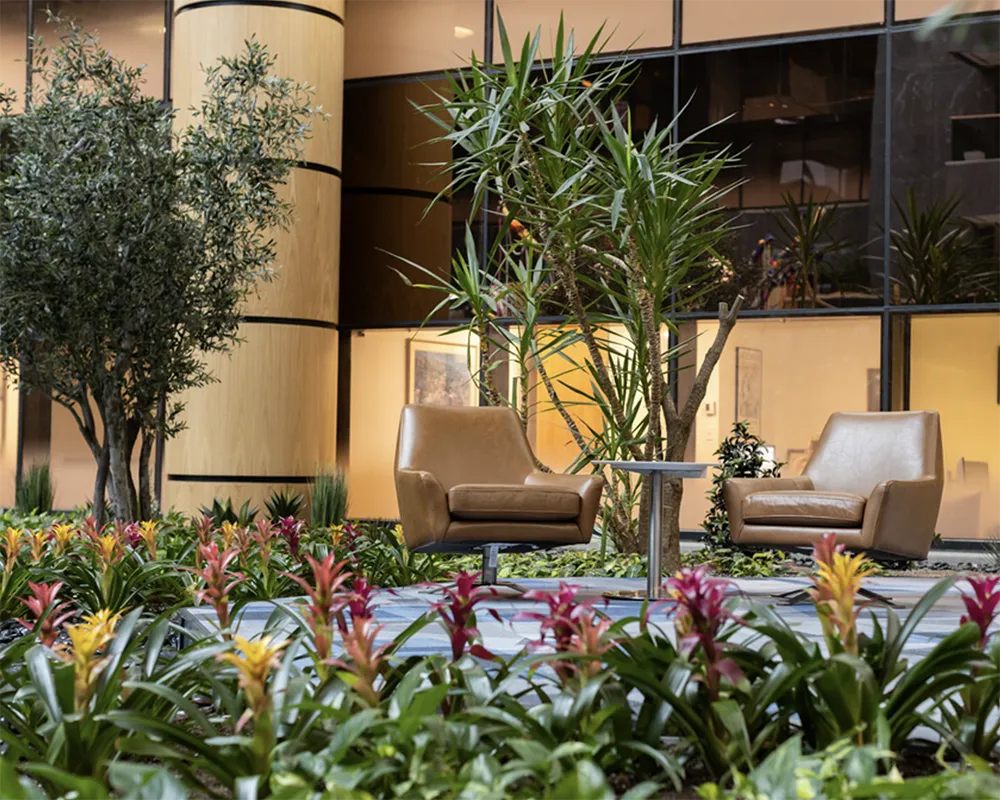
The 15th Pattern: The New Science Breakthrough of AWE
AWE is an emotional response that stops us in our tracks. It’s an overwhelming sense of amazement – like the view from the top of a mountain after a hike. Or walking through the doors of a cathedral, listening to powerful music, or contemplating the depth of the stars in the sky.
And now AWE is the official 15th pattern of biophilic design.
As mentioned earlier, the 14 patterns established by Terrapin Bright Green have been the gold standard. And now with AWE, it goes farther than that. The addition of Awe as the 15th pattern, recognized in late 2022, marks a monumental shift in how we approach the biophilic design concept. It moves the discipline from simply creating “comfortable” or “healthy” spaces into the realm of creating profound, transcendent emotional experiences.
According to Browning and Ryan in the winter issue of Living Architecture Monitor, “ the experience of AWE can make us feel smaller, humble and more charitable. These are feelings that tend to shift our focus from exclusively on ourselves and more to the bigger context of the world and people around us. We tend to exhibit more prosocial behavior after an AWE experience. These are outcomes that are unique among the patterns of biophilic design, and clearly one that have great societal value.”
The Psychology Behind Awe
Psychologists, such as those at the Greater Good Science Center at UC Berkeley, have studied awe extensively. They define it as the feeling we get in the presence of something vast that challenges our understanding of the world. Vastness does not only mean physical size; it can be a vastness of time, complexity, or beauty.
When humans experience awe, our nervous system actually calms down. The “fight or flight” stress response is mitigated. We experience a release of oxytocin, a hormone associated with bonding and trust. This is exactly why the prosocial behavior mentioned by Browning and Ryan occurs. In a corporate office, an awe-inspiring space can reduce interpersonal conflict and foster deeper teamwork. In a healthcare setting, awe can distract from pain and lower patient anxiety.
By adding Awe to the established biophilic design principles, science is confirming what great architects have intuitively known for centuries: the scale, beauty, and integration of nature can physically alter human morality and behavior for the better.
Implementing AWE in Biophilic Architecture
How do designers take this abstract emotion and turn it into concrete biophilic architecture? Achieving the 15th pattern requires a bold approach to spatial planning and botanical integration.
Biophilic architecture that successfully evokes awe usually relies on a few key strategies:
- Vastness and Scale: Utilizing incredibly high ceilings, sweeping atriums, or plunging visual depths. When a person walks into a room and looks up to see a 40-foot living wall stretching toward a skylight, the sheer scale of the natural element triggers awe.
- Unprecedented Greenery: A few potted ferns will not trigger the 15th pattern. Awe requires density, vibrancy, and a feeling of an all-encompassing ecosystem. This means utilizing indoor trees, massive moss walls, or cascading vines that drape over architectural balconies.
- The Interplay of Light: Combining the 6th pattern (Dynamic & diffuse light) with grand scale. When natural light is manipulated to spotlight a massive piece of interior nature, it creates a cathedral-like reverence.
- Unexpected Nature: Placing a vibrant, thriving natural element in a place where the brain does not expect it—such as a subterranean concourse or the center of a heavily industrialized corporate floor—creates a cognitive shift that leads directly to awe.
Architects and designers hold the power to shape human experience. By consciously applying the biophilic design concept through the lens of awe, you are no longer just erecting buildings; you are building psychological sanctuaries.
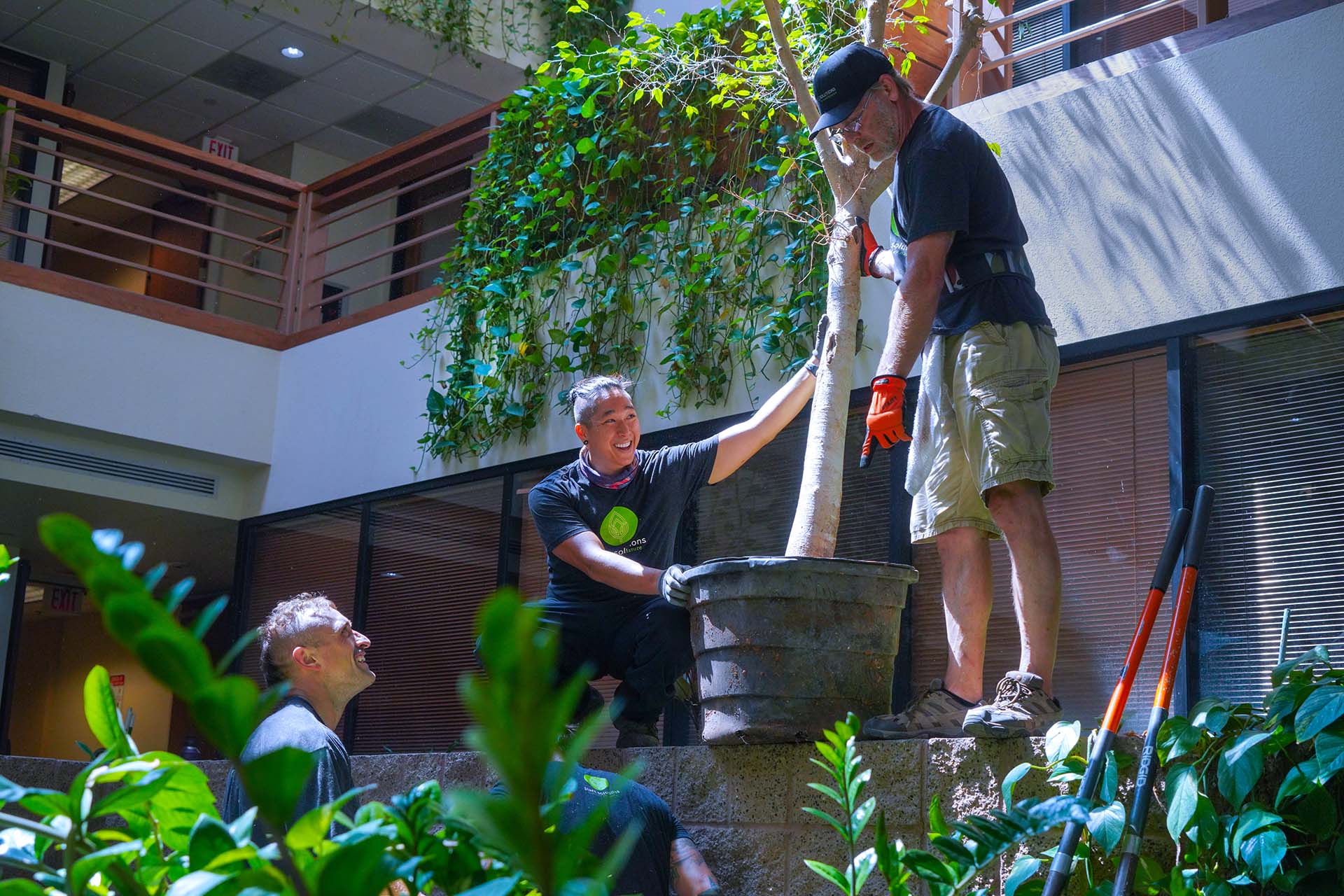
Plant Solutions Transforms Spaces Into AWE-Inspiring Environments
Irrigation systems by Plant Solutions help save water. So, what does this mean for interior landscapes? And Plant Solutions? This latest scientific affirmation and proof, pushes us to go even further in creating an experience within the space. To go grander and use plants to not only expand the physical volume and scale of the environment but also the perception thereof and the way our mind processes it.
When designing biophilic architecture, the inclusion of living, breathing plants is often the most complex element to manage. Plants require specific lighting, specialized hydration, and ongoing maintenance to thrive indoors. Without expert execution, a grand design intended to inspire awe can quickly become an eyesore of failing foliage.
This is where Plant Solutions bridges the gap between the theory of biophilic design principles and functional, stunning reality.
We provide:
- Expert Consultation: Working side-by-side with architects during the blueprint phase to ensure the structural requirements for awe-inspiring interior landscapes are met.
- Custom Living Walls: Designing and installing massive vertical gardens that immediately trigger the 15th pattern of biophilic design by introducing incredible scale and biomorphic complexity.
- Advanced Irrigation: Utilizing sustainable, smart irrigation systems that protect the building’s infrastructure while ensuring perfect plant health, all while saving water.
- Comprehensive Maintenance: Guaranteeing that the initial awe a user feels on day one remains just as potent on day one thousand.
At Plant Solutions, we thrive on creating wonderment and AWE – and improving the built environment in which we live, work and play. We don’t just provide plants; we provide the psychological benefits of nature meticulously engineered for your space.
The Future of Biophilic Design Principles
As we look toward the future of architecture and interior design, it is clear that the inclusion of Awe as the 15th pattern is just the beginning. The principles of biophilic design will continue to evolve as neurological and psychological sciences advance.
What remains constant, however, is our fundamental, biological need for nature. By embracing the full spectrum of the biophilic design concept—from the simplest visual connection to the grandest experience of awe—we can build a world that is not only structurally sound but emotionally enriching. We can design spaces that make us kinder, more collaborative, and deeply connected to the earth.
Let this breakthrough be the catalyst for your next big project. Move beyond standard aesthetics and aim for the extraordinary. Aim for Awe.
Are you ready to transform your commercial or residential space with the breathtaking power of nature?
Learn more about our methodology and how we integrate the 15th pattern of biophilia into everyday environments.