
The benefits of indoor plants for people
Indoor plants offer a wide range of benefits, enhancing both physical and mental well-being. From improving air quality to boosting productivity, incorporating plants into indoor environments has become a well-established practice.

How indoor plants benefit people
Most everyone will agree that being connected with nature and plants is beneficial to the human spirit. This fact is proven by the increased use of interior landscaping in office environments and large businesses. Using an abundant amount of large plants to separate workspaces first became popular in the 1960s. Since then the practice has been promoted and is understood now as biophilic design.
Employee productivity, morale, and efficiency are shown to be improved as well as a reduction in absenteeism when plants and nature are present in the workplace. Compared to the cost of retaining employees, interior landscaping is an economical investment both in the company and its employees.
Plants contribute to a more favorable environment overall. They reduce background noise and lead to better acoustics that improves concentration. They can also be used to define spaces in an open concept office, leading to privacy in an otherwise open environment.
At a Plant Solutions, we can use plants to transform any environment. We are experts in the living wall industry and can create a one of a kind piece of art using living plants that will provide your office with all the benefits plants have to offer without taking up any horizontal space.
Want to enjoy the stress-reducing, productivity-boosting benefits of plants—without the hassle of maintenance? Our plant rental service provides lush, expertly cared-for greenery for your office or home. Elevate your space today!
Get Started with Plant Solutions
Research and Limitations
One of the first studies done in the United States on the effect of office plants in the workplace was done in 1967. A test space was built for DuPont in Wilmington, Del. this space occupied one floor of an office building while the rest of the stories remained conventionally designed. The reaction of employees was generally positive, and the reduced installation and renovation cost, as well as increased office efficiency, was noted. The only negative that came from this first study was that some employees complained of lack of privacy.
In more recent studies employees are generally found to be more productive and attentive, and less stressed than employees in an environment without plants. Another finding is that dust accumulation in the atmosphere with plants is less than the traditional environment which points to improved air quality for the occupants of the naturally designed space.
The conclusion of studies done at the beginning of biophilic design and more recently all find that interior landscaping is undoubtedly an essential component of the office environment. The benefits of interior plants have been proven over and over.
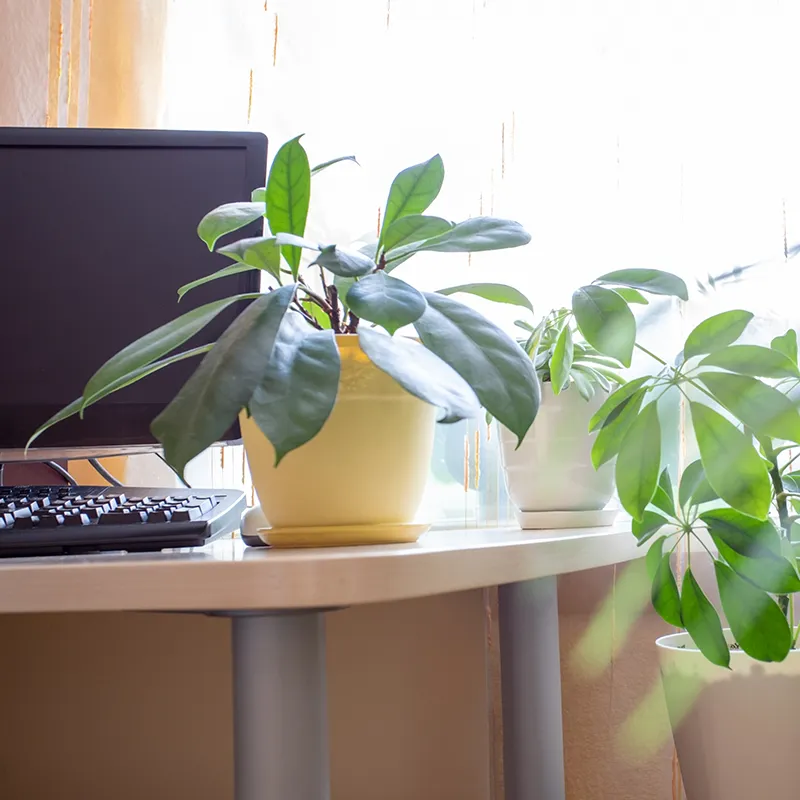
What Plants are used in Plantscaping Studies?
Large potted plants are commonly used in interior landscaping studies. These plants are usually 12 to 14 feet tall and can be used alone because their size draws natural attention. Ficus trees, palms, and dracaenas popular in these studies. Plants that have unusual forms are studied as well. The marginata is often grown with intriguing bends and twists in its trunk and is an excellent focal point for these studies. Bright colored plants are also beneficial for these studies because they are hard to miss. Plants can be used alone or in combination with others.
In sound absorbing studies ficus trees, peace lily’s, dracaenas, arboricolous, and heartleaf philodendrons were most effective. Bark mulch on the surface of the soil was also found to absorb excess noise. Research has proven that plants reflect and diffract sound waves improving acoustics. Plants that have a lot of small leaves make interior spaces less noisy by scattering sounds.
Plants can either be stand-alone focal points or part of the complete office design. For example, plants can direct the flow of foot traffic in the office and establish a walkway.
Biophilic design is more than buying a few plants and putting them in the office. Our horticultural experts here at Plant Solutions will know where to place plants to achieve the physical, mental, and emotional benefits they offer.
Visit our website today to learn more about biophilic design and all the benefits it has to offer. You can check out our gallery to see some of our past designs and get an idea of how we can transform a space.
Transform your office into a more productive, refreshing, and inspiring environment with our plant rental services. We handle the design, installation, and care—so you can focus on thriving.